
scroll
Five ways to show a home that does not exist yet
Attention can no
longer be bought.
It has to be built.
We build the five things that let a family walk through a home before it exists — large-format screen rooms, headset sessions, AR off the printed page, digital twins and websites you fly rather than scroll — and the real-time software underneath all of them. Everything moving on this page is ours, and it is running.
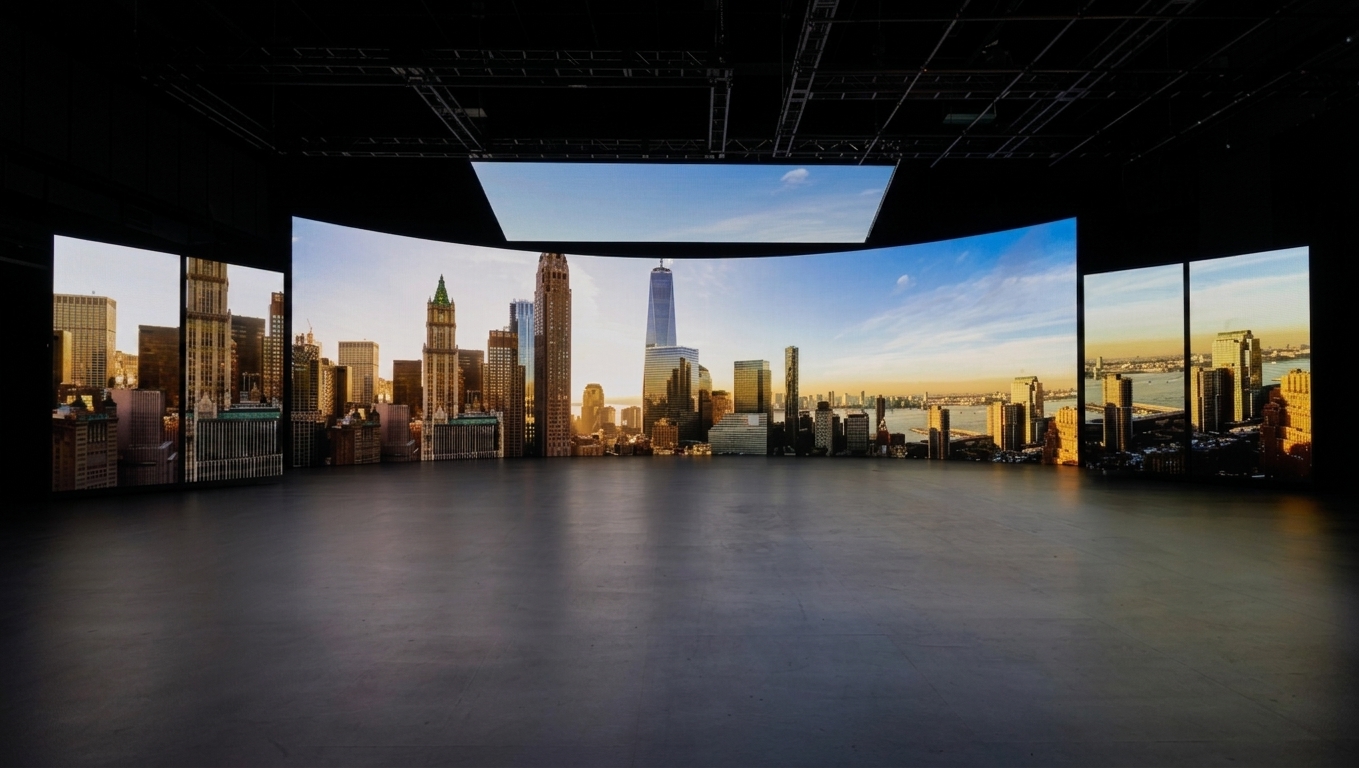
Touchpoint 03 of 05 · the scheduled visit
The walkthrough theatre.
Every other touchpoint travels to the buyer. This one makes the buyer travel, because it exists nowhere else in the city.
A film that becomes a walkthrough.
The room opens with an immersive short that pulls the family into the project. The film dissolves into the project itself. Then your executive takes the controls and walks them through any home they ask about, without breaking the spell.
/01
Attention before facts
Light, sound and scale earn the room's full attention before a single specification is mentioned. You are not competing with anyone's phone.
/02
Settled in the room
Live inventory, unit comparison and the EMI arithmetic sit inside the experience. Questions get answered there, not in an email a week later.
/03
Operated by your team
Tap-to-advance chapters built for a salesperson. If it needs us in the room to work, we built it wrong.
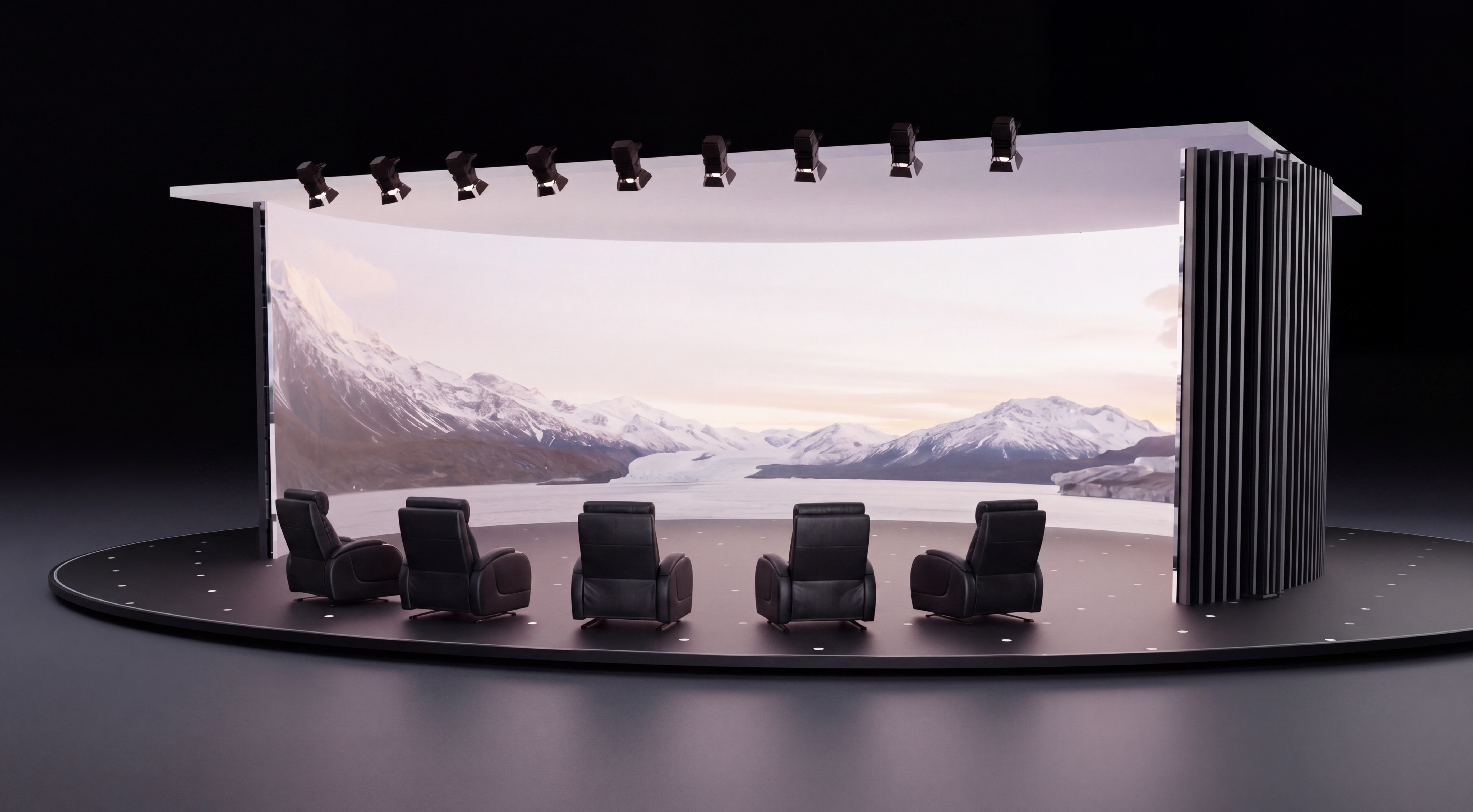
in one of these
You are selling something nobody can experience yet.
A tower that is a hole in the ground. A brand promise. A show that has not opened. Three different businesses, one identical problem.
We build in all three. The room is largely the same room. What changes is the number you are judged on, so pick your column and we will use your language for the rest of this.
A / Developers & sales galleries
The site visit is your best-converting asset and you have no lever to pull on it.
Every other touchpoint travels to the buyer. Only the gallery makes the buyer travel. Roughly one in ten gallery visits becomes a booking for most developers, and the teams who are properly good at it run several times that. The gap is almost never price. It is that the buyer could not picture it, and nobody in the room could fix that with a brochure.
Judged on
Site visit → booking
B / Brands, launches & agencies
Eighty-five per cent of what you buy gets under two and a half seconds.
Below the threshold at which memory measurably changes. You are not short of reach, you are short of any single moment long enough for a new idea to be recognised. That moment is not sold by any media owner. It gets built.
Judged on
Contiguous attention & earned reach
C / Venues & attractions
Your novelty half-life is about six months and the refresh bill never stops.
Operators budget ten to twenty per cent of original build cost every year just on keeping content alive. Roughly half report installation problems traced to calibration and space. Dwell and repeat visitation are the only two numbers that matter, and both decay unless something is designed to stop them.
Judged on
Dwell & repeat visitation
content, commissioning
It opens as a film. It ends up as a walkthrough. Most people never notice the join.
Lights down, sound up, nobody's phone out. Then someone takes the controls and goes wherever the room asks to go, without the spell breaking.
That handover is the only genuinely clever thing in the room and it took us four goes to get right. The film earns the room because it is big and loud and there is nothing else to look at. It dissolves into the real thing, and your host is already driving before anyone clocks that the movie stopped. Do it the other way round, open on a menu with a cursor sitting on it, and you have told the whole room it is software. It never recovers.
Attention before facts
Nothing gets specified until the room has gone quiet, which scale and sound do in about forty seconds. You are not competing with a phone in the dark.
The hard questions get answered here
Live inventory, comparison, pricing and the arithmetic sit inside the experience. Not in an email next Thursday, by which point they have cooled off and someone else has called them.
Your team runs it, not us
Tap-to-advance chapters built for a person on a shift who has already done nine of these today. If it needs us in the room to work, we built it wrong.
Real-time, so it is not stale by March
A rendered film is finished on delivery. Change a price, add a tower, swap a finish and you are commissioning a re-render. Built in a real-time engine most of that is a Tuesday afternoon, and your team can do it. This is what stops the six-month novelty cliff.
drag
01
Curved panoramic
The curve is what stops a person finding the edge of the picture. Seated, for a family or a press pack.
02
Infinity screen
Screen-to-floor continuity, so the surface has no visible bottom edge.
03
Three-sided
Peripheral vision filled on both sides. The cheapest route to genuine enclosure.
04
Full 360°
No back wall to break the spell. Hardest to author for, and the one people photograph.
05
Projection onto a scale model
Mapped onto the physical model you already own. Loudest reaction per rupee, and it installs in a night.
We design the screen around your room. Not your room around a screen.
Most installations are a rectangle bought from a catalogue and then apologised for. Geometry should come last, after the story and the sightlines, because geometry decides whether the illusion holds when someone turns their head.
This is the only part that touches the building. If the space is already up it almost certainly still works, and one visit tells us which format fits. Occasionally it tells us your ceiling height rules out the one you wanted, which is far better to know in week one.
A film plays. A room answers.
This is the line between a very expensive cinema and an immersive experience, and it is the part almost nobody sells you. A real-time build changes with the crowd in front of it, with the hour, with live data, with what the person just chose.
Outernet found this out early. A piece in the Now Building scaled its motion and sound to how many people were in the space. Two hundred visitors, around forty of them ended up lying on the floor looking at the ceiling. Nobody lies on the floor for a video wall.
Crowd density, position, gesture, dwell. Faces, not identities.
Motion, sound, light and narrative scaling to the audience actually present.
Their unit, their configuration, their colourway, their name. Rendered live.
Dwell, path, drop-off, what held them and what lost them. Reported weekly.
You have already bought a version of this. It shows one flat.
A model home costs what a model home costs, and nobody in your business calls that expensive, because it sits on the construction line rather than the marketing line. For that money it shows a single unit type, to the people standing in front of it, during working hours, in one city. It cannot be moved. It cannot show the view from the twenty-second floor, because there is no twenty-second floor yet. And when the project closes it gets stripped or knocked down, and the money leaves with it.
A room shows every unit you have, at any orientation, at whatever hour of the day the family asks about, and then it travels to the next project and does it again. The digital twin of that model home does the same thing for anyone with a link, at eleven at night, from Dubai.
We are not asking you for new money. We are asking you to look at where the old money already goes, and at what it stops doing the day the project closes. That is the comparison. Not the one against your media plan.

Ten minutes, seated, hosted the whole way.
A headset is the smallest immersive room there is, and it travels. To a gallery, a dealership, a trade stand, a boardroom, twelve cities in a fortnight.
Nobody is handed a device. It is a private screening with your person watching the identical view on a screen alongside, so they can talk about what the guest is looking at. Nobody is left alone with something they have never used, and nobody has to admit in front of their family that they cannot find the button. That one detail is most of why these sessions land.
Ten minutes is deliberate. Long enough to build the memory of having been somewhere, short enough that nobody starts working out how to politely stop. We have watched people at fourteen and it goes flat.
The awkward bit, before you find it in a Bloomberg piece.
Vision Pro flopped as a consumer product. IDC put shipments at roughly 45,000 units for the whole 2025 holiday quarter. Apple has cut its Vision Pro advertising in the US and UK by over 95%. The next real version is not expected until 2028 or 2029.
Which is good for you, not bad, for two reasons.
Nobody owns one. That is the entire mechanism. If every guest had one at home, sitting down in yours would be worth nothing. The scarcity is the experience, and yours is the only place in the city they can try it.
There is no version two coming. The usual reason to stall on hardware is the fear of buying six months before the good one lands. That risk is off the table until the end of the decade, so one purchase covers a whole launch or sales cycle.
The exact thing they are considering. Not a generic version of it.
The unit they are actually looking at, facing the way it really faces, with the sun where it will really be at the hour they will be standing in it. Sunrise on the balcony where his parents will take their tea. Guests arriving at dusk. When they lift it off they miss a place they do not own yet.
The same applies to a car in the colourway they configured, or a suite they will stay in next spring. It is the one format where "yours" is literally true.
And the same shell, in her language.
One space rendered in several interior languages, contemporary minimal through to properly traditional, as stills and short transformation films.
This fixes the quietest problem in premium inventory, which is monotony. Forty near-identical units, photographed once, sold forty times off the same picture. Half your buyers cannot see themselves in the styling you chose and they will not tell you. They will just feel lukewarm and blame something else. The renders then work everywhere: the gallery loop, the site, social, the brochure QR codes.
A record, not a render.
Your finished model home, captured on site in a single day, accurate to the centimetre, and open to anyone with a link. Below is a live one. Drag to look, click to move — it is exactly what your buyers would receive.
/01
It becomes the benchmark
What the twin shows is what you deliver. Every buyer measures the handover against it — uncomfortable only if you were planning to disappoint them.
/02
Open at 11pm, from Singapore
Her quieter second look. His parents from the old city. The NRI shortlist across three time zones, without a flight.
/03
It listens while it sells
Stagings by theme, guided narration, lead capture, live chat inside the tour, and heat-maps of what each family lingers on.
/04
It outlives the model home
The physical model flat gets repurposed. The twin does not close.
fewer days on market — 34 days down to 19 — across 43,000 homes. The only peer-reviewed number on this page.UT Dallas, Information Systems Research, 2025
of buyers say they are more likely to buy a home that has a 3D tour.Matterport consumer survey, n=2,000 — vendor research, treat as directional
say they would buy without visiting in person when a 3D tour exists. That is your NRI desk.Matterport consumer survey, n=2,000 — vendor research, treat as directional
A site they explore, not scroll.
A conventional site tells. This one hands over the controls. Below is a live project site of ours — fly the masterplan, open a zone, land in a unit.
/01
A world, not a page
Masterplan, zone, tower, unit — one continuous journey instead of a menu of brochures.
/02
Clarity closes distance
Orientation, views, sun path, amenity walks. Questions that normally need a site visit, answered from a sofa at midnight.
/03
Unit-level intent data
Which tower, which floor, how long on each. The enquiry tells you what they were looking at when they raised their hand.
The page opens the gate.
A buyer at this level is not reached by mass advertising. He is reached by what arrives through trusted hands. So the magazine spread, the brochure on his desk and the card in his pocket each become a private showing. One scan in a phone browser — no app — and the building stands up off the paper.
/01
Press and hoardings
Scan the page and the community rises in 3D. Explore amenities, walk a home, book a visit. Print stops being reach and starts being response.
/02
Brochures that get re-opened
3D floor plans lift off the page. The piece gets picked up again to show other people — which is what a brochure normally fails to do.
/03
Measurable, by placement
Scans logged by publication, page and hoarding. Print becomes something you optimise rather than repeat.
No single touchpoint reaches everyone who decides.
This is the honest argument for the system over any one piece. A luxury home is almost never decided by one person, and almost never in the room where it was presented. Read down the first column: each touchpoint reaches a different person at a different moment. That coverage is the thing you cannot buy piecemeal.
| Touchpoint | Who it reaches | Where | When | What it produces |
|---|---|---|---|---|
| 01Digital twin | One person at a time, then forwarded to the family | Anywhere with a browser | Any hour, often outside your working day | Return visits — the behaviour that predicts a booking — plus a record your handover is measured against |
| 02Immersive website | The researcher, often the NRI relative doing diligence | Desktop, sitting down | Earliest real contact, before any call | Unit-level intent data and a shortlist built without your team's time |
| 03Walkthrough theatre | The entire family together, plus channel partners | Your gallery only — it cannot travel | The scheduled visit | A reason to make the drive, longer meetings, and a story that generates referrals |
| 04Apple Vision Pro | One person, hosted — usually the one not yet sold | Your gallery, seated | Late — where a shortlist becomes a decision | The booking conversation, and a memory rather than information |
| 05AR across print | Whoever holds the paper, then whoever they hand it to | The desk, the drawing room | First contact, before you know they exist | Attribution on print for the first time, and a piece that gets re-opened |
Each of the five has its own detailed pitch — the problem it solves, the engagement it creates, and everything that arrives. Ask for any of them, or all five.
2019–2026
The media you buy is measured in impressions.
Those two numbers stopped agreeing some time ago, and the gap is where most marketing budgets go to die.
The threshold for an ad to leave a trace in memory sits at about two and a half seconds of active attention. Not served, not viewable. Actually looked at. Almost nothing clears it.
The same researchers have since found the exception, and you should hear it from us rather than from your agency. Where a brand is already sitting in someone’s head, a second and a half is enough to refresh it. Which is fine if you are a bank or a biscuit. A tower nobody has heard of, on a road nobody has driven down, is not sitting in anybody’s head. There is nothing in there to refresh. You are not topping up a memory, you are trying to start one from nothing, and that is the one job short exposure has never been able to do.
of digital placements get under 2.5 seconds of active attention.
Dr Karen Nelson-Field / Amplified Intelligence · biometric attention panelof the audience still watching at second one, against second three. Attention does not fade. It falls off a cliff.
Amplified attention decay curveof out-of-home placements do clear the threshold. Not better creative. A different situation.
Amplified channel comparisonThe user experience defines how much attention you pay.
Dr Karen Nelson-Field
Founder, Amplified
That is the most useful sentence in modern marketing and almost nobody acts on it.
Attention is not a property of your creative. It is a property of the situation your creative arrives in. The same film, cut by the same editor, gets one second in a feed and forty seconds in a room. Nothing about the film changed. A person waiting at a bus stop is simply in a different situation from a person scrolling, and the environment did the work.
Which means the room is the variable almost nobody is testing. Every brand on earth is optimising the message. Very few are changing the situation it lands in, and the science says that is the larger lever of the two.
It also explains the objection you will hear from finance. Someone reduces a room to floor area times footfall, divides by cost, produces a CPM and calls it expensive. Rory Sutherland has a name for that error: the doorman fallacy. You decide a hotel doorman’s function is opening a door, replace him with an automatic one, and only later notice you also removed security, status, welcome and the reason people talk about the place. Everything the room was for gets deleted from the spreadsheet before the comparison runs.
Frequency works. Right up to the moment you have something new to say.
This is the part that should change how you brief, and it is the reason we exist.
The old assumption was that learning depends only on cumulative exposure, so thirty exposures of one second equalled one exposure of thirty. Controlled experiments took that apart. What they found instead is an identification threshold: a minimum block of uninterrupted time before a person can recognise what they are even looking at. Below that block, repetition does not accumulate. It evaporates.
A familiar message
A known brand, a promise they have heard, a product they could name in a fragment.
Short and frequent works. The threshold is crossed before the ad starts, because the memory structure already exists. A second and a half refreshes it.
Something genuinely new
A launch. A repositioning. A tower that does not exist yet. A category nobody has a slot for.
Long and rare works, and extra frequency buys almost nothing. No number of one-second exposures will assemble an idea the audience cannot yet identify.
So the honest question is not whether immersive works.
It is whether the thing you have to say survives being compressed into a second and a half.
If it does, buy reach. Buy it cheaply, buy it often, and do not let anyone sell you a room. We say that in first meetings and we have lost work by saying it.
If it does not, and that is true of nearly every pre-launch and every premium proposition that needs understanding before it can be wanted, then frequency is not a smaller version of the right answer. It is the wrong instrument, bought in bulk.
What you need is contiguous time. No media owner on earth sells it. It gets built.
You should be suspicious of a page like this. Be suspicious about proof.
So here is ours, with the names withheld until the client clears them, which most of them will.
None of the five touchpoints above is a concept or a showreel. Each one is live for a property client right now, and every capture on this page came out of those builds. We will name them in the room, and we will put you on a call with the person who ran it, which is the only reference that is worth anything.
/01
Walkthrough theatre & digital twin
Residential, Hyderabad
In the sales gallery, operated by the client’s own team. [ONE number you can stand behind — movement in visit-to-booking, median dwell, or meetings per visit]
/02
Immersive website
Masterplan community
Live and taking enquiries with unit-level intent attached to each one. [enquiry quality or shortlist figure]
/03
AR across print
Press, brochure, hoardings
Browser-based, no app, scans logged by placement. [scan volume, or the placement that outperformed]
/04
Apple Vision Pro
Hosted sessions in gallery
Ten-minute seated screenings, run by the client’s executives. [sessions run, or what it did to second visits]
/05
Outside property
Training & hospitality
Work that was not allowed to fail, including a driver-training programme delivered ahead of schedule and a branded twin for a hotel group. [keep only the figures you can evidence on request]
Why there are no logos on this page. Most of this work sits behind an NDA, and the ones that do not are launches whose marketing teams would rather announce it themselves. We would rather show you five live links in the meeting than five logos here.
The questions we get in the second meeting.
How is this different from an AV integrator plus a film company?
+
In who carries the joins. An integrator is accountable for the screen working and a film company for the film being good, and both can succeed completely while the experience fails, because nobody was accountable for the content matching the geometry, the audio matching the image, or the whole thing being legible to a stranger who walked in mid-loop. We take that single line of accountability, which is why we insist on doing the master build rather than inheriting three.
Everything you would show is unbuilt. Where does that leave us on RERA?
+
Where you already are, with one more thing on your side. We build from your sanctioned drawings rather than from a mood board, so what the room shows is what the approval says. Anything indicative is labelled indicative inside the experience itself, not in six-point type on the last page of a brochure. And because every surface inherits from one master build, you end up with a dated, versioned record of exactly what was shown to which buyer on which day — which is a stronger position than the one you are in today, where the thing being represented is a salesperson’s verbal description of a view. The digital twin goes further again: it is a capture of what you actually delivered, so the handover gets measured against a record instead of a memory. If your legal team wants to sit in the week-one session, bring them. It is the cheapest hour in the project.
We already have a big LED wall. Can you just give us content?
+
Yes, and it is a large part of what we do. One site visit tells us the screen mesh, blend regions, viewing positions and black level, and we author against those rather than delivering a flat file and hoping. If your wall was specified without a content plan, and most are, we will tell you plainly what it can and cannot hold.
Which do we start with, the room or the headset?
+
The room, nearly always. It works on everyone who walks in, including the people who would never put a headset on, your team can run it all day, and it changes the shape of the whole visit. The headset is the closer for the person who has come back a second time and is nearly there. Doing the headset first makes a nice press release and a smaller commercial result.
Real-time or a rendered film?
+
Rendered if the story is fixed, the run is short and the budget is tight. A launch film, a six-week activation. Real-time if it has to respond to people, change with live data, personalise, or stay alive beyond a season. The honest test: if you will want to change something after launch, rendered means paying us again and real-time means a Tuesday afternoon. We recommend rendered when rendered is right, and we have.
How do we measure it?
+
Four layers. Behaviour in the room: footfall, dwell, path, the moment attention drops. Capture: scans, sign-ups, configurations saved, qualified leads, units blocked. Amplification: shares, reposts, earned coverage, and the volume of footage the room produced, which for a well-designed space is the largest number on the report. And a pre and post lift study on recall and consideration among people who came through, against a matched sample who did not. We set the baseline before we build, not after.
You are fifteen people. Can you carry something this size?
+
Fair question. The four disciplines that decide the outcome are in-house and senior, and they are on your project personally rather than fronting it. Volume production, modelling and asset build runs on a vetted specialist network we art-direct and whose files we own. Hardware and rigging run through named partners at actuals. What you buy from us is the design, the master build, the calibration and the accountability. Some things come back in 48 hours because there is nobody to route them through, and some briefs we turn down because we are already on two rooms.
What happens if we stop working with you?
+
You keep what you paid for. Films, render sets and captures are yours. Interactive builds and the master source are licensed to your project, with ownership, hosting and hand-off written down before any money moves. We would rather have that conversation on day one than with lawyers on day four hundred.
Start here
Nobody buildsa room to sellsomething generic.
Anyone can commission a beautiful film. Anyone can buy the impressions. Neither costs enough to mean anything, and audiences have worked that out.
A room is different, and the difference is precisely that it is expensive. Nobody puts nine unbroken minutes of scrutiny around something they are planning to disappoint you with. So the spend is not the price of the message. The spend is most of why it gets believed.
That is what you are actually buying. Everything above is how we make sure it works on the night.
Bring a floor plan, or just a brief and a date.
And if a room is a bigger conversation than you want this quarter, do not start with the room. Start with the paper, the website or the twin. Those move in weeks rather than months, they cost a fraction, and they will tell you from your own numbers whether the room is worth having the argument about. Most of our developers arrived that way round.
The first session is a working one, not a credentials deck. What you have to say, whether it survives compression, and if it does not, what shape of room fixes that. You leave with a recommendation and a range, and we will tell you if the answer is to spend the money on media instead.
Every screen, room and headset capture on this page is our own work, running live. None of it was built for this document. Sources: Amplified / Dr Karen Nelson-Field on active attention and the 2.5-second threshold; exposure-duration research on the identification threshold; Indian sales-gallery conversion reporting; Sphere Entertainment filings and reported rate card; Outernet London B2B disclosures; DCT Abu Dhabi, May 2026; IDC and Sensor Tower via the Financial Times on Vision Pro; immersive-venue operator surveys on dwell, refresh and calibration.